

The term ontology is old and comes from philosophy. At its core, it’s about what exists and how things relate to each other. In the early 1990s, AI researchers brought the same idea into IT. The difference was that the things and their relationships were described explicitly enough for a computer to use them.
So why did an old and odd word hit me this hard? We have been working our asses off around AI from different perspectives for a long time at Netox. Our brilliant Modern Work & Copilot consultants have been paving the way for AI adoption at our customers with great success. At the same time, I’ve been scratching my head over how to use AI in service production and different areas of our business in a way that actually improves our competitive advantage.
Somehow I feel these are two different approaches to two different problems. The first one focuses on improving the productivity of individuals and teams. Agents are the key players here. The latter could be called enterprise AI: use AI where it hurts the most. It’s often a pretty good way to get enough attention for the initiative.
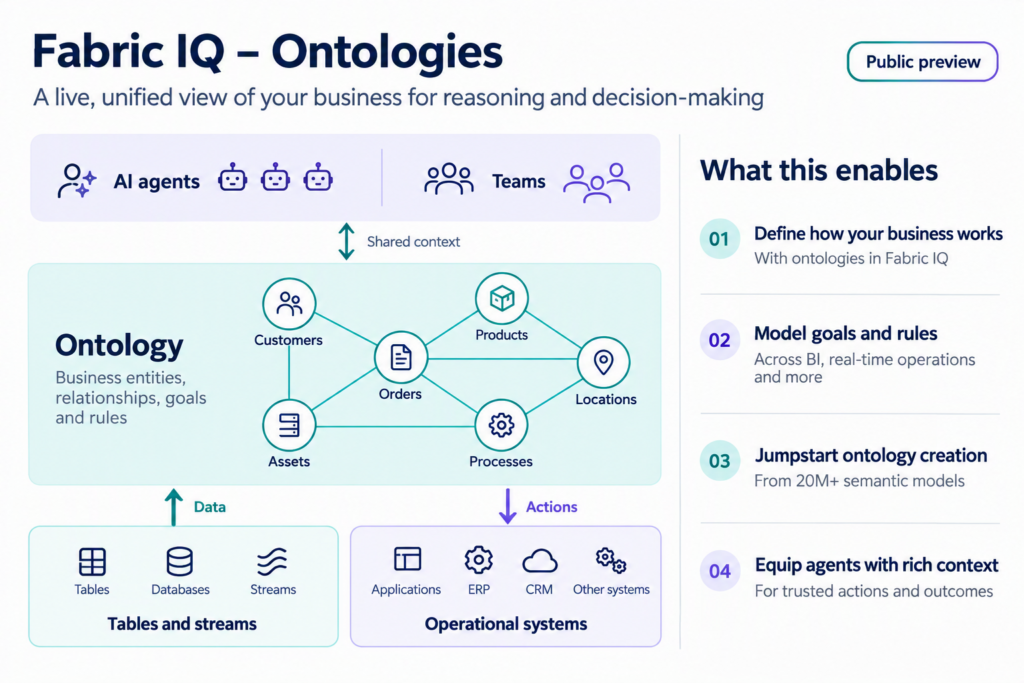
I believe ontology, when applied correctly in the AI world, can blow the roof off. A company ontology is a structured map of how the company works. It starts as a vocabulary, which is basically just a set of words. Add links and rules between the words, and the vocabulary becomes an ontology. Populate it with your real processes, services, owners, systems and so on, and it turns into an ontology graph.
Just by following the map, you should be able to answer many questions about how the company works, or find the person who knows more, or the system and record where the detailed data lives.
Imagine what would happen if you could give that map as context to all the AI in your company.
That’s what Microsoft Fabric IQ is made for. Building the ontology graph is not trivial, but with the help of AI it’s absolutely achievable in a reasonable amount of time and effort. I built the first prototype within a week of discovering the whole idea. The key was to first understand the building blocks and then turn the theory into practice. My process went roughly like this:
- Define the vocabulary. The first version had 18 words.
- Define how the words relate to each other and the rules that connect them. This turns the vocabulary into an ontology in its purest form.
- Feed your existing company data into the ontology. This is called structured extraction. In practice, the ontology works as a filter for what you are looking for in the documents.
- See if anything important was left out. Add the missing concepts and run the same documents through it again. Keep adding more documents and repeat.
- Once the structure starts to look complete, remove unused concepts and compare the model with relevant frameworks. In our case, ServiceNow CSDM 5.0.
- Fill in the missing information manually. For example, services, processes and owners that weren’t identified.
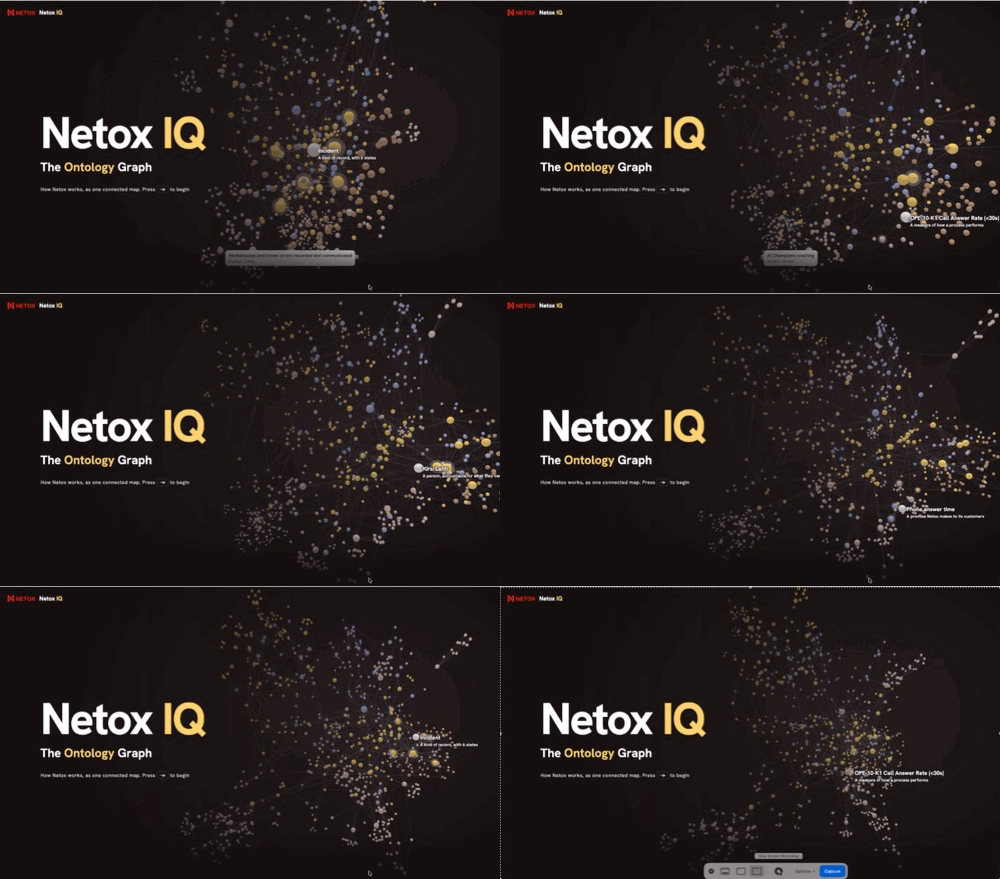
What you have now is an ontology graph.
When our first prototype was finished, I was able to try the first use cases. It could already answer questions like these:
- Who owns this? Pick any process, service or system, and you get the responsible role and the person behind it.
- What changes if we replace this system? You get every process, service and integration that depends on it.
- What’s missing? Processes without an owner or a KPI, and customer promises that nothing measures.
And once AI agents can access the ontology graph, things get even more interesting:
- One intake for all feedback and ideas. You report an idea, a bug or a flaw in one place. The agent knows whether it’s about a service, a process or a system, and who should get it.
- Questions across systems. Which services cause the most incidents but bring in the least invoicing? The data sits in two different systems, but the map tells the agent where to look and how things connect.
Imagine if we could feed all of this into Fabric IQ and let every Copilot chat, Copilot agent and even other AI agents take advantage of it. I’m pretty sure this changes the game: AI no longer helps just an individual or a team, but can operate on top of the structure of the entire company.
What’s next?
First, we need to go through the model with the people who actually own our processes and services. So far, I’ve been the only one reviewing the output and filling in the missing pieces. In this case too, the data needs to be right before we can let AI trust it.
After that, we need to figure out which data already exists in our Fabric data platform and which needs to be fetched directly from the source systems, where possible. Then comes the best part: publishing the ontology to Fabric IQ and building a data agent on top of it. That’s how Copilot and other agents get access to the ontology.
The first test question from a user’s Copilot could be a simple one: Who owns this?
After that, we’ll go through the rest of the Microsoft IQ pieces. We already have Work IQ in use. It brings context about what people actually do in Microsoft 365: their email, meetings, documents and chats. Web IQ and Foundry IQ are not in use yet. Web IQ helps manage public web sources and define which sources we as a company want to trust. Foundry IQ helps agents find the right information in documents.
So, does ontology connect productivity AI and enterprise AI? I strongly believe it does. I just can’t prove it yet.